Circular economy:Re-thinking the process

Circular economy treats materials like they’re finite, is based in a make-use-return model in which the company maintains the ownership of the products.

35

Shoes: the company recycles and re-designs the shoes when they reach the end of life and also uses recycled consumer waste to manufacture the new shoes.

To transform the shoes, I’m gonna design them with five interchangeable parts so they will be easy to disassemble, and I will use wool, bamboo, elastic wires and recyled PET plastic from consumer waste. Once the shoes reach the end of life, they are disassembled and recycled, separating the parts and materials and then re-manufacturing and re-distributing them.

1

Trousers: the retailer leases the trousers and provides repairs when needed. In addition, trousers that can’t be repaired, are recycled, re-manufactured and re-distributed to the retailer.

To transform the trousers, I’m gonna design them thinking in the reparation, so I will make them with wool and I will separate them in two parts, because then they will be easy to recycle.

2

I have chosen these products because I think that they are easy to re-think and they are necessary for our life.
 

ZERO WASTE LIFESTYLE

Imatge relacionadaResultat d'imatges de zero waste lifestyle

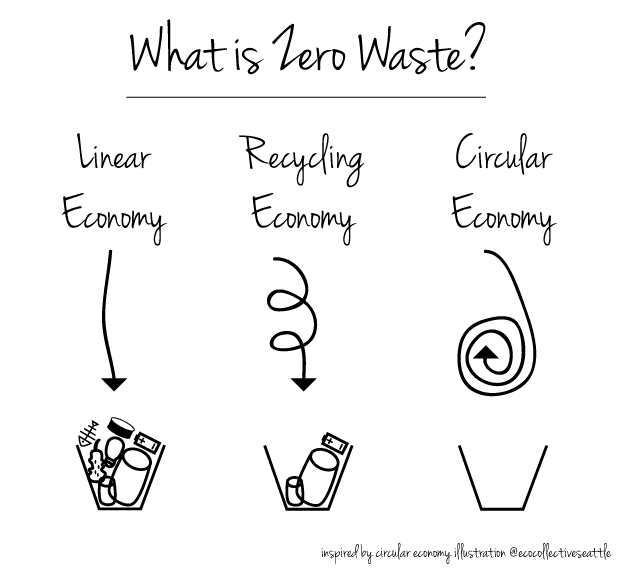
Regarding the TEDxTeen zero waste video, I think the zero waste lifestyle is very interesting because it is the opposite of the linear economy, the current mainstream trend of the world. It is like circular economy, which takes care of the environment and nature. It helps the environment because instead of discarding resources, they can be resumed fully back into the system. Besides, the rubbish ruins and affects the animal life, specially sealife. Global nature and landfills also take profit of the zero waste lifestyle, because with it there are less pollutant agents in the world.

Resultado de imagen de zero waste

The zero waste lifestyle is possible for me because I can search how to reach it, like making my own products and buying seconhand. It is interesting to consider the benefits I could get from this lifestyle, like saving money (because the products are homemade and seconhand bought), eating better because there is no need to buy processed food (derives in more energy and less sleep), more organization and feeling better.

My list of daily thrash: one plastic food package, one can, cooking paper and one plastic bag.

I could downsize my rubbish by refusing clutter in my house, buying in the market  with a cloth bag and buying secondhaded.


100% clean energy by 2045 in California

The last 10th of September the Gov. Jerry Brown signed the law «SB100» (sponsored by state Sen. Kevin de León), that sets three targets: 50% of renewable by 2026 and 60% by 2030, and 100% carbon free energy by 2045.

To get these targets, California could create big budget solutions, like a smarter electricity grid, development of high-capacity electricity storage or a natural gas processing plant with carbon capture and storage in combination with nuclear to get the energy that renewable energy couldn’t afford to generate.

Similarly, other states have set a Renewable Portfolio Standard (RPS) with goals, like Hawaii (100% by 2045), New York (50% by 2030), Orlando (50% by 2045), Colorado (30% by 2020), Arizona (50% by 2030) and Nevada (50% by 2030).


DSIRE RPS 2016_0

descarga (1)